

Psychology is the scientific study of mind and behaviour. Studying Psychology at Gresham’s can have a positive impact on pupils as they gain greater insight into their own behaviour, thoughts, feelings and attitudes. They are learning not just about a fascinating subject but also about themselves.
Psychology is the study of human behaviour, so if a pupil is interested in what makes a person ‘tick’, they are curious about what makes people similar and yet unique, then Psychology is the subject for them. Psychology can lead onto a variety of careers, including training to be a Forensic, Occupational, Sports or Educational Psychologist. It is also highly relevant to those wishing to study medicine or law or who are a budding entrepreneur. Ultimately, Psychology is a versatile subject which fits with a wide variety of subject combinations. Combined with English Literature it allows an understanding of the motivations of a character in a Bronte novel; with Economics it is understanding why consumers will buy a product even though there are cheaper alternatives on the market; with Biology it encourages the exploration of alternative arguments for human behaviour with more emphasis on the role of the environment.
“Studying Psychology is fun because you’re always looking for the same things I think a writer should be looking for, which is the story behind the story.”
CHRIS CLEAVE, BRITISH WRITER AND JOURNALIST
Who is the course suited to?
Both the IB Diploma and AQA A level courses have a strong emphasis on scientific methods, including maths/statistics and it should be noted that most university courses regard Psychology as a science. Thus, we recommend that pupils have achieved at least a Grade 6 in a Science and Mathematics at GCSE level.
The method of assessment does include essay writing and it is expected that pupils will read widely to consolidate classroom teaching, thus, a Level 6 or higher in English would also be recommended.
What is essential is enthusiasm, commitment, curiosity, and a genuine interest in the subject.
What skills will be learnt or developed?
Transferable skills including the ability to analyse and evaluate information; complete academic research using the internet with discretion; communicate effectively and reflect on their own performance.
- A LEVEL PSYCHOLOGY
Entry requirements: A Grade 6 or better in GCSE English and Science would be preferred. A Grade 5 or better in GCSE Maths would be beneficial. What is essential is enthusiasm, commitment, curiosity and a genuine interest in the subject.
Exam board: AQAStudying the A Level course will benefit those wishing to read Psychology at university; in addition, through studying Psychology pupils are well equipped for many other degree courses where understanding human behaviour is valuable, including: Sciences, Sociology, Criminology, Politics, Business Studies and Economics, Teaching, Sport Science, Law and Nursing.
Future career choices are diverse and exciting. There are many opportunities within the field of Psychology itself, for example: applying psychological principles in the criminal justice system as a Forensic Psychologist; supporting children in an educational setting as an Educational Psychologist; working with patients to diagnose and treat mental health conditions as a Clinical Psychologist, enhancing athletic performance as a Sports Psychologist and helping organisations improve employee wellbeing and productivity as an Occupational Psychologist.
With advancements in technology, there are new and ever developing areas of Psychology too, such as Neuropsychology and Cyberpsychology. With their transferable skills, pupils of Psychology go onto many varied careers outside of applied Psychology, such as Business and Marketing, Teaching and Law.
Psychology is the scientific study of human behaviour, and the A Level course provides the opportunity to
develop an excellent grounding in key areas of Psychology:Introductory topics in Psychology: Four topics, all studied in Year 1.
- Social Influence
- Memory
- Attachment
- Clinical Psychology and Mental Health
Psychology in context: Three topics studied in Year 1 & 2.
- Approaches
- Biopsychology
- Research Methods.
Issues and options in Psychology: Four topics studied in Year 2.
- Gender
- Schizophrenia
- Forensic Psychology
Issues and debates: Studied in Year 1 & 2.
- Nature v Nurture
- Gender and Culture Bias
- Determinism v Free will.
Assessment:
Three papers at the end of the two year course, each worth 33.3% of the final mark.
- IB PSYCHOLOGY
Entry Requirements: A Grade 6 or equivalent in (I)GCSE English and Science would be preferred. A Grade 5 or equivalent in (I)GCSE Maths would be beneficial. What is essential is enthusiasm, commitment, curiosity, and a genuine interest in the subject.
Studying the IB course will benefit those wishing to read Psychology at university. In addition, the study of Psychology equips pupils with skills that are useful for many other degree courses where understanding human behaviour is vital, including: Sciences, Sociology, Criminology, Politics, Business Studies and Economics, Teaching, Sport Science, Law and Nursing.
Future career choices are diverse and exciting. There are many opportunities within the field of Psychology, for example: applying psychological principles in the criminal justice system as a Forensic Psychologist; supporting children in an educational setting as an Educational Psychologist; working with patients to diagnose and treat mental health conditions as a Clinical Psychologist; enhancing athletic performance as a Sports Psychologist and helping organisations improve employee wellbeing and productivity as an Occupational Psychology.
With advancements in technology, there are new and ever developing areas of Psychology, too, such as Neuropsychology and Cyberpsychology. With their transferable skills, pupils of Psychology go onto many and varied careers outside of applied Psychology such as Business and Marketing, Teaching and Law.
The aims of the DP Psychology course are for pupils to:
- Develop knowledge and understanding of psychological concepts, content and contexts including models and theories.
- Think critically and creatively about behaviour and cognitive processes.
- Engage with problems facing individuals, groups and societies using psychological understanding and
skills.
Pupils will explore the biological, cognitive and sociocultural explanations for human behaviour through the study of psychology applied in four real-life contexts:
- Learning and Cognition
- Pupils will study cognitive processes, with a focus on memory. They will also learn about the principles of learning and models of thinking and decision making, including the role of cognitive biases
- Health and Wellbeing
- Pupils will explore the factors affecting health problems such as social media addiction or drug misuse. They will also explore one mental health condition in detail e.g. depression in terms of diagnosis, explanation and treatment
- Human Relationships
- Pupils will study factors influencing group behaviour; they will also explore the development of and factors affecting interpersonal relationships
- Human Development
- Pupils will study models of human development and factors involved in the development of self
The course has a strong focus on psychological research and so pupils will conduct a practical research study relevant to each context. For this reason, pupils will also study Research Methods throughout the course, so they develop an in depth understanding of how to conduct and analyse and critique psychological research.
Assessment:
At HL there are three IB examinations at the end of the two-year course – Paper 1, Paper 2 and Paper 3.
At SL there are two IB examinations at the end of the two-year course – Paper 1 and Paper 2.There is a strong focus on Research Methods, the application of psychological knowledge to unseen studies and scenarios, and the evaluation of studies and theories using psychological concepts.
- Paper 1 – Integration of concepts, content and context (SL = 35%; HL = 25%)
- Paper 2 – Research Methodology – applying concepts and content to research contexts (SL = 35%; HL = 25%)
- Paper 3 (HL only) – Source based questions – data analysis and interpretation of research data (30%)
Internal Assessment (HL and SL)
The IA is worth 20% for HL pupils and 30% for SL pupils. It consists of a Psychology research proposal to investigate a topic in relation to a specified population of interest.
- ACTIVITIES AND SOCIETIES
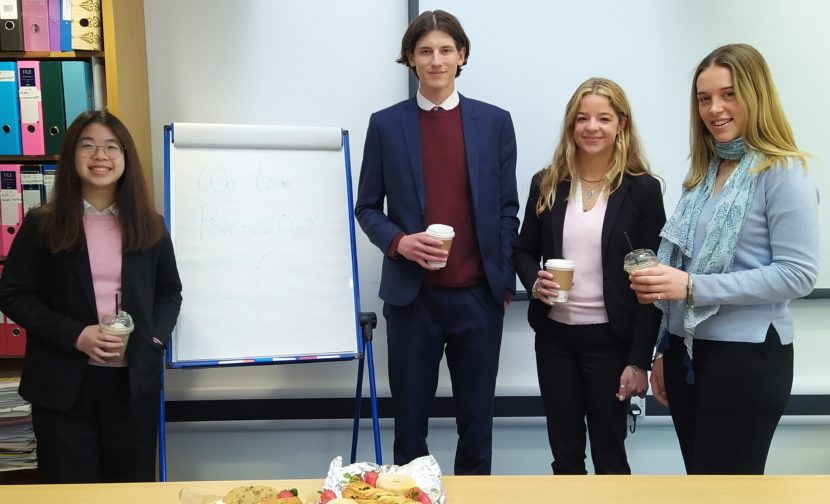
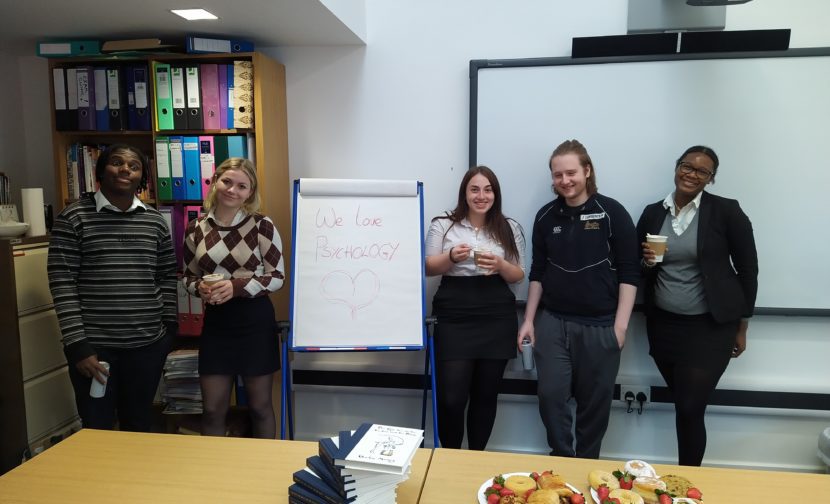
The Psychology Society
The pupil-led Psychology Society meets every Half Term as a way for current Year 12 and 13 pupils, prospective pupils in Year 11 and simply anyone interested in Psychology to meet and explore a topic outside of the curriculum. Pupils present on a topic that interests them, which is followed by a question and answer session and general discussion. Recent talks have been about empathy, aggression, and the influence of neglect on child development. It is an excellent opportunity for pupils to enrich their knowledge of Psychology and to gain experience of researching a topic in depth and presenting to their peers. Pupils are encouraged to extend their knowledge and interest in Psychology through reading books and articles, listening to podcasts, and watching TED talks which extend their understanding of the subject. This often leads to pupils volunteering to give a society talk.
ALUMNI
Hannah Farndon neé Pike
Policy Advisor for Professional Practice at the British Psychological Society (BPS)
Crossways/Oakeley 1998
Hannah is Policy Advisor for Professional Practice at the British Psychological Society (BPS). She advises the Society’s Practice Board and leads on the development of guidance for psychologists. Some of the key areas of her focus include dementia, children and young people’s mental health and autism.
Hannah studied psychology and completed a Masters in Forensic Psychology at the University of Leicester. Before joining the BPS, Hannah worked as an intelligence analyst for Leicestershire police.
CHARLIE ADAMS
KENWYN/HOWSON’S 2020
“I loved studying Psychology at A level, as it gave a great insight into the human mind and behaviours. I really enjoyed being able to apply the concepts into everyday life, helping understand why people act in different ways and what makes people unique. I particularly enjoyed studying Social Influence, investigating obedience and legitimacy to authority, and Forensic Psychology, looking at criminal profiling. I have taken my interest in Psychology further by studying Sport Psychology as a module on my degree.”
ISABELLA SCHMID
EDINBURGH 2020
Isabella is currently studying Arts and Sciences at UCL. “I really enjoyed the IB Psychology course and the insight it gave me into human behaviour, especially the biological and socio-cultural aspects of the course. Learning about methodology and ethics in psychology has allowed me to develop crucial analytical skills that I have been able to apply to my studies at university in subject areas outside of Psychology and has allowed me to look at research from a range of perspectives. Since completing the IB, my interest in Psychology has continued to grow and I am now studying neuropsychology as part of my degree.”